
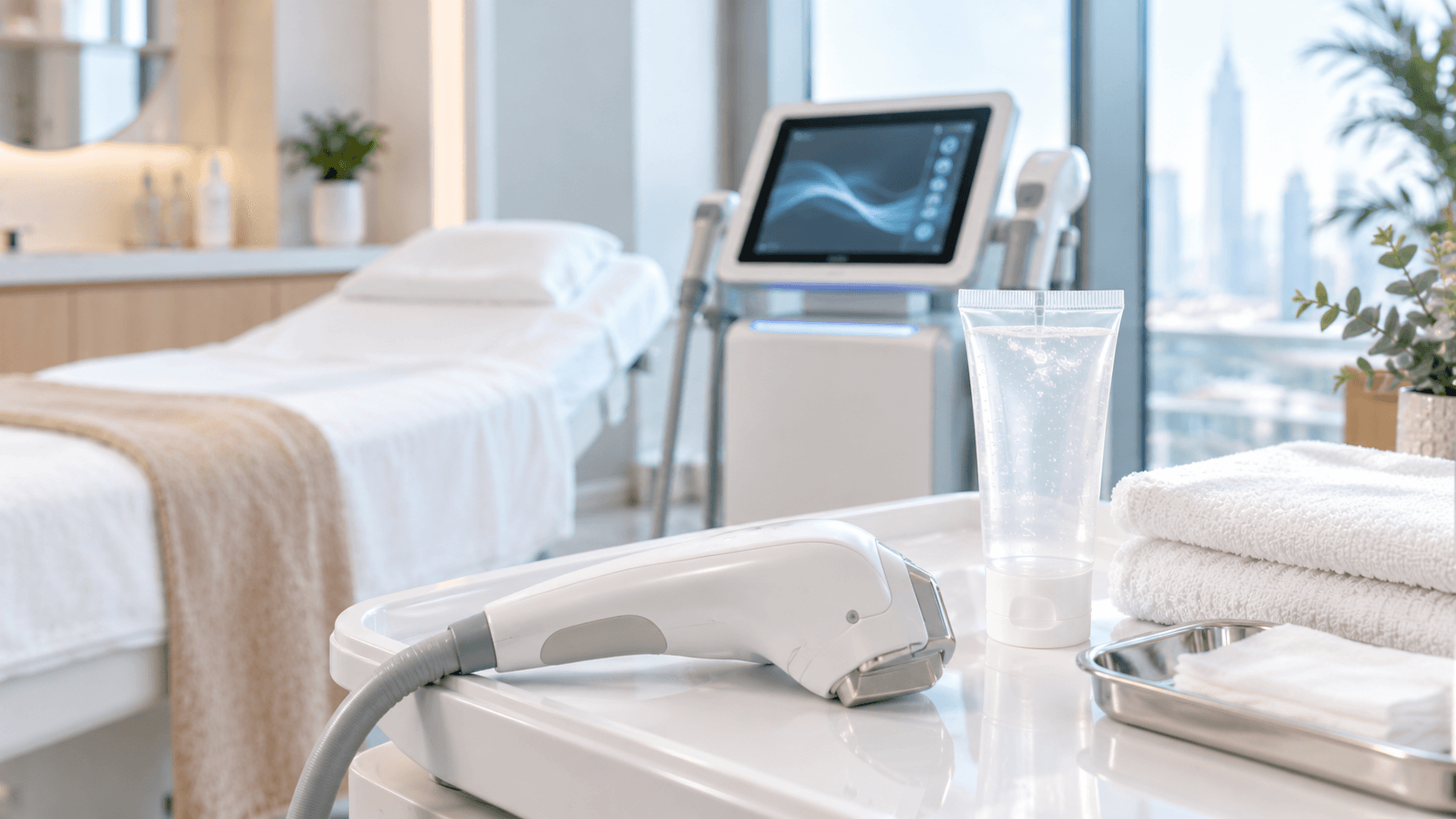
If you are looking for a non-surgical way to address mild skin laxity, two names come up again and again: HIFU and Ultherapy. Both use focused ultrasound energy, both work beneath the skin’s surface, and both are often described as “lifting” treatments. So what is the difference, and how do you know which one might suit you? This guide explains how HIFU treatment and Ultherapy work, how the two compare, who tends to be a candidate, and what the process and recovery involve.
Both are medical treatments, and suitability and results vary from person to person. The information here is general and does not replace an assessment by a licensed doctor.
What HIFU is
HIFU stands for high-intensity focused ultrasound. Ultrasound is sound energy at a frequency too high for us to hear. When it is focused to a precise point, it creates a small amount of heat at a chosen depth below the skin, while the surface layer stays largely unaffected.
A HIFU device delivers many tiny points of focused heat in lines across the treatment area. These points are placed at specific depths, which can include:
- The deeper dermis, the supportive layer of the skin
- The SMAS (superficial musculoaponeurotic system), a layer of connective tissue beneath the skin that surgeons also work on in a surgical facelift
The heat creates small zones of controlled injury. In response, the body starts a natural healing process that includes building and remodelling collagen, the protein that gives skin its firmness. Because this happens gradually, changes develop over the weeks and months after treatment rather than straight away.
“HIFU” describes the technology, not a single machine. Many devices from different manufacturers use it, such as Liftera, and they differ in their handpieces, depths, energy settings and how treatment is delivered. A HIFU facial commonly treats the cheeks, jawline, under the chin and the neck, depending on the device and your doctor’s plan.
What Ultherapy is
Ultherapy is a specific branded treatment that also uses focused ultrasound energy. It works on the same principle as HIFU: heat delivered at set depths to trigger collagen remodelling.
Its main distinguishing feature is built-in ultrasound imaging. The device shows the practitioner a live picture of the layers beneath the skin while treating. This allows them to see the tissue they are targeting and place energy at the intended depth.
Ultherapy is one of the most studied focused ultrasound treatments, and it is usually performed in a single session, although some people choose to repeat it later. If you are considering Ultherapy in Dubai, ask your doctor how the treatment plan would be tailored to your face and neck.
Key differences
In simple terms, Ultherapy is a type of focused ultrasound treatment, while HIFU is the broader category that includes many devices. The practical differences usually come down to the following:
| Factor | HIFU (general devices) | Ultherapy |
|---|---|---|
| What it is | A technology used by many devices | A specific branded device |
| Energy | Focused ultrasound | Focused ultrasound |
| Imaging during treatment | Usually none | Live ultrasound imaging of the tissue layers |
| Typical number of sessions | Varies by device; one or more | Usually one, sometimes repeated later |
| Comfort | Varies by device and settings | Can be more noticeable at deeper depths |
| Cost | Often lower | Often higher |
Neither option is automatically “better”. The right choice depends on your skin, your goals, the areas to be treated and how comfortable you are with the process. A doctor experienced with these devices can explain which approach fits your situation.
Who is a candidate
Focused ultrasound treatments are generally considered for adults who:
- Have mild to moderate skin laxity on the face, under the chin or on the neck
- Want a non-surgical option with little downtime
- Understand that changes are gradual and vary between individuals
They are usually not the right choice for people with significant sagging or excess skin, who may be better served by a discussion of surgical options. A doctor can help you weigh this up honestly.
Focused ultrasound may not be suitable, or needs extra caution, if you:
- Are pregnant or breastfeeding
- Have an open wound, active infection or active acne in the treatment area
- Have metal implants or implanted electronic devices near the area
- Have had fillers or other injectables in the area recently, since timing may need to be planned
- Have a tendency to keloid scarring or certain autoimmune or skin conditions
Your doctor will review your medical history and examine your skin before recommending either treatment.
Sessions, downtime and aftercare
A typical appointment follows these steps:
- Consultation and planning. Your doctor assesses your skin, discusses your goals and maps the areas to treat.
- Preparation. Make-up is removed and the skin is cleaned. Some clinics apply numbing cream or offer other comfort measures.
- Treatment. A thin layer of gel is applied, and the handpiece is placed on the skin. The device delivers energy in lines across each area. With Ultherapy, the practitioner also watches the imaging screen.
- Finishing. The gel is removed, and the skin is cleaned.
Many people feel warmth, tingling or brief deeper aches as the energy is delivered, especially over bony areas. How it feels varies by device, depth and individual sensitivity, so tell your practitioner if you are uncomfortable.
Downtime is usually minimal, and most people return to normal activities soon afterwards. Temporary effects can include:
- Redness, which usually fades within hours
- Mild swelling
- Tingling or tenderness to the touch
- Occasional bruising or small welts
- Rarely, temporary numbness or nerve-related effects
Contact your clinic if you notice anything that worsens rather than settles, or if you have concerns.
General aftercare often includes being gentle with the skin, avoiding very hot environments and harsh skincare for a short time, and using a broad-spectrum sunscreen daily. Your doctor will advise when, or whether, a repeat treatment might be appropriate.
Price factors in Dubai and Abu Dhabi
The cost of focused ultrasound treatment varies, and quotes usually depend on:
- The device. Ultherapy and other HIFU devices are priced differently.
- The areas treated. A full face and neck costs more than a single area.
- The number of lines or shots delivered during the session.
- The number of sessions recommended.
- The practitioner’s experience and training with the device.
Be cautious about very low prices. Ask which device will be used, whether it is a genuine device with authentic cartridges, and who will perform the treatment.
Which suits you?
Both HIFU and Ultherapy use the same core idea, focused ultrasound to encourage collagen remodelling, but they differ in device, imaging, process and cost. The best way to decide is a consultation with a licensed doctor who can examine your skin and explain the options honestly. You can learn more about the procedure in Dubai and about HIFU treatment in Abu Dhabi on Skin111’s HIFU page.
FAQs
Is Ultherapy the same as HIFU? Ultherapy is a branded focused ultrasound treatment with live imaging. HIFU is the wider technology used by many devices.
When will I see a change? Changes develop gradually over the following weeks and months, and vary between people.
Does it hurt? Most people feel warmth, tingling or brief aches. Comfort measures can be discussed with your doctor.
Is there downtime? Usually very little. Redness or mild swelling is common for a short time.
Can it replace a facelift? No. It is a non-surgical option for mild to moderate laxity, not a substitute for surgery.